- This article is about the comic series. For other uses, see Sonic the Hedgehog (disambiguation).
Sonic the Hedgehog was a long-running series of American comic books published by Archie Comics with the help of Sega, featuring Sega's mascot video game character, Sonic the Hedgehog. It ran from July 1993 to February 2017. Spin-off publications from the comic included a Knuckles the Echidna series starring the titular character, which ran for 32 issues; fifteen 48-page "Super Specials"; eight single special issues; and four short three-issue miniseries, each starring a character from the series. On 21 September 2005, Archie Comics started a new series based on the Sonic X anime. On 24 February 2009, Archie Comics produced their first issue of Sonic Universe, which contained four-issue stories that took place at the same time as the main series. This comic featured a mixture of characters, settings, and situations from the Sonic the Hedgehog cartoon, the Sonic the Hedgehog video games by Sega, and various other incarnations of Sonic. It also included many elements unique to the comic.
The comic series was recognized in the Guinness World Records for being the longest running comic series based on a video game.[1] The final issue of the main series was issue 290, released in December 2016. Following an undisclosed hiatus in early 2017, Sega of America finally announced on 19 July 2017 that they ended their publishing partnership with Archie Comics, therefore ending the comic series.[2] The license for a Sonic comic was quickly moved over to IDW Publishing, where a new comic series began publication, with much of the Archie Comics' former staff, such as Ian Flynn and Evan Stanley, being rehired.
Former writer Ken Penders attempted to make a film based on the franchise under the name of Sonic Armageddon which film was originally an idea by Ben Hurst who wanted to make the said film a revival of the Sonic the Hedgehog SatAM television series in place of the cancelled third season. However, this film never saw the light of day.[3] If it did, it would be the only animated media related to Archie.
The situation regarding Sonic comics from Archie Comics outside of the United States has changed considerably over time. Some early stories of the series were published in Finland by a Finnish publisher in the mid-1990s.[4] In Brazil, Editora Escala published a small number of Portuguese-language editions of Archie Comics stories in the 1990s.[5]In the 2000s, Archie's Sonic became an essentially American product, almost non-existent in the official international market. The series has not had its entire collection officially published outside the United States; many countries have published only parts, selected translations, or for short periods. Non-American fans and collectors often resorted to importing American editions (in English, without translation) or following scans and (unofficial) translations on the internet from American English into their respective languages.
Overview
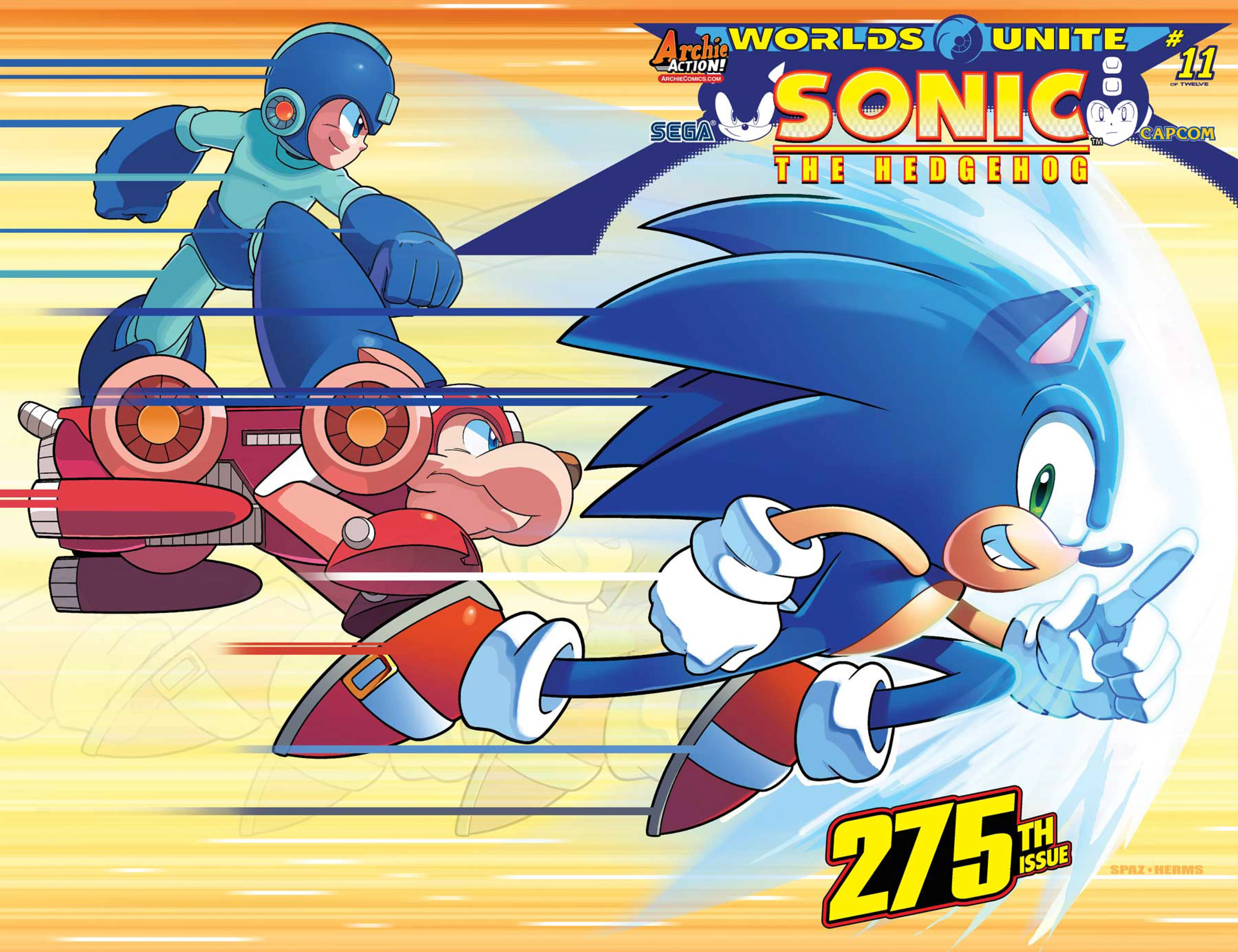

The comic series' final milestone, Sonic the Hedgehog #275.
The comic's main focus was the adventurous story of the titular character, the world-famous hero, Sonic the Hedgehog. The hedgehog loves adventure and chili dogs and he is always willing to fight to protect the ones he cares about from any threat. Sonic is in some ways different from his video game counterpart - in the comics, he was displayed as having important familial ties, and engaging in romantic relationships; characteristics absent from most other incarnations. He was also portrayed as having a deeper sense of duty - in the games at the time of the series, Sonic treated his ongoing conflict with Dr. Eggman as just an opportunity to have a fun time, whereas in the comic series he understood it as a responsibility to protect his world from a terrible menace, although he did seem to have fun while fighting Eggman.
Sonic's age was left intentionally ambiguous due to relativity resulting from his recent space travel. It is likely that Sonic's actual biological age is somewhere between sixteen and eighteen, whereas in the games at the time, his was nearly always referred to as fifteen.
The comic occasionally implied that "Sonic" is just a nickname. According to former writer Ken Penders, Sonic's true first name in the comic's continuity is "Olgilvie Maurice Hedgehog". However, this was never mentioned in any story and is not considered canon. Current writer Ian Flynn has stated that he won't be revisiting the topic and is content with simply calling the hero Sonic. In any case, his middle name has been stated to be "Maurice" and his actual last name is "Hedgehog."
However, this no longer matters as the "Worlds Collide" event reset the universe and the new universe became more in line with the games.
Setting
At the beginning of the series, the year is 3235, now it is the year 3237. Sonic lives on Planet Mobius in Mobotropolis. Other notable areas of setting include Knothole Village, the Angel Island, Station Square, Downunda and New Megaopolis. It was revealed in issues 125 and 148 that Mobius is actually a future Earth (in an alternative reality and in Sonic X, it is officially present on Earth), the year being 14,016 CE. It is unknown why the Mobian year is so low by contrast, though it is speculated that the year was reset during the events known in Echidna theology as the "Days of Fury" (when Isaac's creators Professor Clarke & Doctor Niven attempted to preserve Earth's environment after the Xorda used the gene bomb, which ended disastrously).
Following the aftermath of the Worlds Collide event, the entire universe had been reset and changed.
Storyline
The original issues of the series and those soon to follow consisted mostly of isolated stories. That is, there was rarely any continuity between issues. However, there were the additions of new characters (such as Bunnie Rabbot, Knuckles, and Super Sonic) that would become familiar and lasting faces as the series continued. The early issues featured much of Sonic versus Robotnik, in which Sonic would constantly foil Robotnik's plans whether it be to tear down a forest or find the hidden location of Knothole Village. Eventually though, the issues started to gain a sense of an ongoing story, most notably with the addition of the Mecha Sonic story line in issue 39, in which Sonic is transformed into a robotic form and does as Robotnik commands. This would later be concluded in a Sonic Special issue where Knuckles gives himself up to be transformed into a robot in order to defeat Mecha Sonic. From here, the story line would be further developed into what is now a fully continuous one. Following the defeat of Mecha Sonic, the Freedom Fighters come together in issue 46 to discuss ways to attack and defeat Robotnik once and for all. The loyalty of many of the Freedom Fighters comes into question, particularly notable in a feud between Sonic and Geoffrey Saint John, a member of the Acorn secret service. This continues into the renowned End Game saga which takes place over a four issue span, #47 through #50.
The saga begins with a mission by the Freedom Fighter and the Wolf Pack, led by Lupe, to attack Robotnik’s base. Princess Sally reveals thoughts of her father, King Acorn, telling her that it would soon become apparent that Sonic is a traitor. The mission proceeds and Sally is in need of help or she may fall to her death. The Freedom Fighters look on in despair when they think they see Sonic and assume that he will rescue the princess. Much to their surprise, Sonic aids Sally in falling to her death. The mission is called to retreat, and the Freedom Fighters move back to Knothole village. Meanwhile, Sonic is seen battling Robotnik inside the base (when he apparently left Sally for dead). Robotnik escapes and Sonic leaves the base wondering where the rest of his companions have gone. Sonic returns to Knothole only to be arrested and spared the death penalty in light of all his services, so instead is sentenced to life in prison on the Devil’s Gulag, where other notorious traitors such as Sleuth Doggy Dog (#42) will be imprisoned with him. While Sonic is being transported to the Gulag, Swatbots attack the vessel and it crash lands. Sonic remains conscience and takes the opportunity to escape. News bears word and King Acorn demands the recapture of Sonic by Saint John. Sonic on the run, takes refuge in a cavern. Meanwhile, Bunnie and Antoine discover that Drago (a member of the Wolf Pack) has been working with Robotnik in order to frame Sonic. This is followed by King Acorn issuing Robotnik as his new Warlord. Sonic, in the meantime, continues his run from Saint John and the secret service with aid from Dulcy the Dragon. Robotnik reveals his duplicate of the King by making it self-destruct and the true plan has become evident to all. All this would lead up to Sonics return to Knothole in issue 50, where Sonic clears his name and heads to a final showdown with Robotnik. As the issue notes, Sonic is uncharacteristically devoid of humor as he approaches Robotnik. In the battle, Robotnik’s ultimate annihilator crashes and the room is destined for destruction, but Robotnik and Sonic remain to fight. In the end, Sonic emerges victorious and Robotnik dies. Sonic later revives Sally with a kiss.
Story lines continue to follow after the End Game saga. Ixis Nagaus makes his first appearance in issue 53. Although temporarily defeated, he would later return in issues 64 through 66, along with the appearance of Nate Morgan, former adviser of King Acorn, and Ixis would be defeated this time by Ultra Sonic, one of Sonics transformations.
Issue 75 reveals that an alternate version of Robotnik that Sonic faced in issue 19, known as Robo-Robotnik, survived the last encounter and killed his dimension's Sonic, and after learning about the original Robotnik's death in issue 50, decided to fill out the void in both his and Sonic Prime's life by traveling to Sonic's world sometime in between issues 51 and 62, and taking over Robotnik Prime's place. His presence is revealed by flashbacks to certain issues between issues 50 and 75. Sonic and the Freedom Fighters head to space to battle this Robo Robotnik, and although they defeat him, there are many other bodies standing in line. Robo-Robotnik went into one shaped funny and became who is now Sonic's familiar enemy, Dr. Eggman.
Sonic Adventure was readily adapted into the series with the appearance of Chaos, beginning in issue 79. The saga ends with Sonic successfully defeating Perfect Chaos, the final form of Chaos after absorbing all of the emeralds, by transforming into Super Sonic in issue 84. Sonic does not actually destroy Chaos, as Chaos returns to his ancient beginnings to live in peace.
Issue 85 features Silver Sonic II, a scaled down version of the super robot seen in the Death Egg Saga. The next two issues (#86 and #87) feature the return of Metal Sonic (first seen in issue 25 and once again in the Knuckles' Chaotix special). Despite being able to defeat Sonic and Tails with ease, Metal Sonic realizes he can be more than his programming and sacrifices himself to save Sonic and Tails from a lava flow.
Sonic Adventure 2 comes into adaptation for one issue (#98) featuring Shadow the Hedgehog. The majority of the issue leads up to the events of the game and brings back Silver Sonic II, only to have him destroyed by Shadow.
In issue 125, Sonic's latest battle with the Xorda leaves him stranded in space after saving Knothole from the Quantum Dial, while everyone on Mobius assumed him to be dead. Sonic's journey through space leads up to many interesting story lines, such as the return of Super Sonic in issue 126, and his discovery that Tails' parents are still alive on a far off planet. Sonic returns in issue 130 where he reveals to everyone that he is indeed alive and well. He learns that Eggman has engaged in all-out war with the Kingdom of Acorn and the United Federation (Station Square's population).
Issues 131 through 144 introduce a side story line taking place 25 years in the future. In this future, Sonic is king of Knothole and married to Sally. Knuckles has attained the rank of Guardian and is (unofficially) married to Julie Su. However, all is not well as the timeline is in danger of collapsing into destruction. Sonic and Knuckles try with the help of Rotor to prevent this catastrophe. Sonic ends up saving the universe, but it is, unfortunately, reset with alterations, which are seen in issues 166 and 167.
Issue 145 features the return of Shadow, who continues to be a player, fighting both Sonic and a newly created Metal Sonic, in issues 146 through 149. This arc heavily touched on the history of Mobius (from the original conflict with the Xorda on Earth to prehistoric Mobius). Shadow reappears again in issues 157 through 161, as well as later issues. In issues 180 to 184 Knuckles was tricked by Dr. Finetevus into becoming Enerjak with the help of Scourge and the Destructix. In issues 189 to 196, Scourge and his newly reformed Suppression Squad took over Freedom HQ after Scourge became King Scourge. Robotnik created a Metal Scourge to aid Metal Sonic in fighting the two hedgehog twins. Sonic and Amy invaded Scourge's Moebius and in the hopes that Amy's evil double will help oust Scourge. Miles (Tails' duplicate) made a deal with the Freedom Fighters to have Scourge overthrown. Then things got crazy with Silver entering the series for the first time, Shadow appearing in Scourge's universe trying to find Chaos Emeralds and Eggman sending a Metal Sonic. In the all-out hedgehog brawl that ensued, Scourge used the power of the Anarchy Beryl (the Anti-Chaos Emerald) to make himself invulnerable, but Sonic deceived and defeated him.
In issue 200, Eggman goes insane after his defeat by Sonic, but returns to normal around 10 issues later. During Eggman's period of insanity, Snively allied himself with the Iron Queen and conquered New Mobotropolis. But the conquest was short-lived, and when the Iron Queen was defeated, Snively freed Eggman from prison in order to save his skin.
Issues 225 through 229 featured an arc titled "GENESIS," to celebrate 20 years of Sonic the Hedgehog. In this saga, Sonic finds himself in Green Hill Zone where he finds animals are being captured and imprisoned by an evil genius named Dr. Robotnik and his co-worker, Snively. Upon freeing animals from a capsule, Sonic discovers three Mobians named Sally Acorn, Boomer the Walrus, and Antoine D'Coolette, who were Freedom Fighters against Robotnik's dictation. Sally convinced Sonic to join them on the same mission to defeat Robotnik, to which Sonic accepted. Upon arriving at Scrap Brain Zone, they discovered Robotnik and made a quick victory, but later discovered that the mad scientist was still alive. Sonic then met a young fox named Miles Prower, but Miles preferred the name "Tails." He joined the Freedom Fighters in the second quest to locate Robotnik, where it was discovered that the Oil Ocean Refinery needed to be shut down, as it was used to power Robotnik's Death Egg Mark 2. Sonic journeyed off to the Metropolis Zone (despite Sally's pleas) along with Tails. While the other Freedom Fighters shut down the Refinery, Sonic stormed the Death Egg and battled Dr. Robotnik as Super Sonic using Chaos Energy that powered the battle-station. Enabling Chaos Control, the world began to reset back to the present time of issue 225.
- During the course of events in GENESIS, some of the characters (primarily Sonic and Sally) began regaining their memories from the time before Dr. Eggman reset time with his Death Egg Mark 2, and eventually at the end, all memory was restored.
When everything was reset at the end of the "GENESIS" saga, Dr. Eggman almost lost his sanity again, thus revealing that Eggman's mind is on a very short string. Instead of giving in to madness, though, Eggman tried to fire the Death Egg, which would have destroyed all machines on the planet. Sally foiled his scheme, but was roboticized in the process.
Around the same time Eggman unveiled his new Death Egg, Ixis Naugus returned and demanded that he be made king due to the fact that King Maximillian had technically handed his crown over to him while in the Zone of Silence. With help from Geoffrey St. John and by fighting against the Death Egg, Naugus gained the favor of most of the Mobians and was declared king. Naugus then secretly helped Dr. Eggman by telling him that the Freedom Fighters were providing former King Elias an escort out of New Mobotropolis. The attack left Antoine D'Coolette in a coma and Bunnie left to fight on her own, putting an end to the original Freedom Fighters. In response, Sonic, Amy, Tails, and Rotor formed two new teams. One, Team Fighters, would go take the battle to Eggman while the other, Team Freedom, would be charged with protecting New Mobotropolis. Former King Elias also formed a team of Secret Freedom Fighters that would work outside the law to take down Ixis Naugus and aid Team Freedom in protecting New Mobotropolis from attacks.
After many issues consisting of Team Fighters chasing Eggman and Elias waging a secret war against Ixis Naugus, the comic series entered a crossover with the Mega Man series where evil doctors Eggman and Wily worked together to create a zone between their worlds and then use a second Genesis Wave on each. The evil geniuses then roboticized some of Sonic's friends and tricked Sonic and Mega Man into fighting each other. In the end though, Sonic and Mega Man worked together to stop Eggman and Wily. This time however, when Sonic tried to reset his world, Eggman messed up his concentration and the result was that Sonic's universe has been reset to an alternate timeline, one where Sally is not roboticized, Bunnie is still half-robot and Antoine is not in a coma. To Sonic, this version of reality seems a lot happier than the previous one and he's no longer sure he wants to reset his world back to normal.
The comic detailed not only Sonic's present, but also his past and possible futures. Great attention has been given to his back story, including the lives of his relatives and friends during Robotnik's regime and the Great War that preceded it. As noted above, the comic ran a series of stories called "Mobius: 25 Years Later," Sonic's possible future as King of Mobius. In these stories, we learn that King Sonic has become a recluse and has severed ties with most of his former friends, except for his continuing, strained relationship with Knuckles. The story will soon be continued with a story detailing the events after King Sonic's time travel causes another possible future in which Shadow is king.
The comic's mythology surrounding the Chaos Emeralds and Master Emerald was quite different from what is seen in the games. According to the comic, the Chaos Emeralds were the result of alien radiation reacting with beryl deposits thousands of years ago. While in the games there are only seven of these emeralds, there were hundreds in the comic continuity, with seven "Super Emeralds." In addition, the Master Emerald was created by Tails, who used the Chaos Siphon on several emeralds to unify them. In the games, however, the Master Emerald is thousands of years older than Tails, or anyone else, for that matter. This has recently been retconned by the authors though through "The Gathering" in which Turbo Tails and Super Shadow send all the multicolored Emeralds in the universe to the Zone of Silence. Once the Emeralds are sent there, Feist takes them and combines them into a single gem for each color. He also claims that to receive a Chaos Emerald that he would judge the seeker of the gem. Given the surroundings of the newly reformed Zone of Silence, this judgment will likely come in the form of tasks similar to the special stages of the video games.
Story Arcs
- The bolded titles are major and significant story arcs
In chronological order.
Classic Era
- Sonic Kids (Stories about the childhood of Sonic and his friends)
- Sonic Kids 2 (Stories about the childhood of Sonic and his friends)
- The Beginning (#0-3 Miniseries)
- First Adventures (#1-8)
- Zone Hopping & New Faces (#9-25)[note 1] (+ Sonic: In Your Face![note 2] + Princess Sally miniseries[note 3])
- Other Problems (#26-35 + Sonic & Knuckles [note 4] + Triple Trouble [note 5] + Tails miniseries [note 6] + Knuckles' Chaotix [note 7] + Super Sonic vs Hyper Knuckles[note 8])
- Turning Point (#36-38 + Knuckles Miniseries[note 9])
- Mecha Madness (#39-40 + Mecha Madness Special[note 10])
- Preperations For War (#41-46 + Sonic Quest Miniseries[note 11] + Sonic Live! [note 12] + Sonic Blast[note 13] + Knucles the Echidna #1-3[note 14])
- Cry of the Wolf (#113)
- End Game (#47-50 + Battle Royal[note 15])
- Effects Of Victory (#51-#55 + Knucles the Echidna #4-6[note 16] + Brave New World[note 17] + Knucles the Echidna #7-9[note 18])
- World Tour (#56-#63 + Return of the King[note 19] + Sonic/Image Crossover[note 20] + Knuckles the Echidna #10-#11[note 21] + Knuckles the Echidna #12[note 22] + Knuckles the Echidna #13-15[note 23] + Knuckles the Echidna #16-18[note 24])
- The Naugus Trilogy (#64-#66)
- Trouble at Home (#67-#70 + Knuckles the Echidna #19-21[note 25] + Sally Moon [note 26] + Knuckles the Echidna #22-24[note 27])
Modern Sonic
- Rise of the Eggman (#71-#76 + Knuckles the Echidna #25 [note 28] + Sabrina the Teenage Witch #28 and Crossover Chaos[note 29][note 30] + Knuckles the Echidna #26-28[note 31])
- A New Beginning (#77-78 + Knuckles the Echidna #29 and Girls Rule ![note 32] + Knuckles the Echidna #30-32 and Turnabout Heroes [note 33] )
- Sonic Adventure (#79-84 + Sonic Adventure (Super Special)[note 34])
- Heading Home Again (#85-#87)
- The Big Payback (#85)
- Heart of the Hedgehog (#86-#87)
- Negative Relations (#88-97 + Sonic Stew[note 35] + Naugus Games[note 36])
- Sonic Adventure 2 (#98 + SU #2)
- No Rest For Heroes (#99-102)
- Freedom Fighters of the Galaxy (#103-104)
- Myth Taken Identity (#103-105)
- Crouching Hedgehog, Hidden Dragon (#106-107)
- Cleaning Time (#108-112)
- When A Mammoth Returns (#114-118)
- Prelude To Crisis (#119-121)
- Heart Held Hostage (#122-123)
- Sonic Adventure 2.5 Omega (#124-125)
- Tossed in Space (#126-129)
- Home (#130-134)
- Mobius: 25 Years Later (#131-144, #166-167)
- The Tommy Trilogy (#135-137)
- Return to Angel Island (#138-141)
- The Original Freedom Fighters (#142-143)
- Shadows Of Hope (#145)
- The Good, the Bad and the Unknown (#146-149)
- The Chosen One (#149-150)
- Evil Sonic Havoc (#151-152)
- Songoose (#153-154)
- Line of Succession (#155-156)
- System Shutdown, Reconfiguration, and Reboot (#157-159)
- Birthday Bash (#160-161)
- The Darkest Storm (#162-164)
- Leak (#165)
- Order From Chaos (#168-169)
- Family Meetings (#170-171)
- Joy Before Cry (#172-174)
- Eggman Empire (#175-177)
- House of Cards (#178-179)
- Enerjak Reborn (#180-184)
- Mogul Rising (#185-188)
- The Bold New Moebius Saga (#189-197) (Made into 4 two-part arcs + 1 Issue)
- A Bold New Moebius (#189-190)
- Metal and Mettle (#191-192)
- Otherside (#193-194)
- Hedgehog Havoc (#195-196)
- Consequences (#197)
- The Battle to Bring Down the Eggman (#198-200)
- Egg Phoenix Down (#198)
- Knocking on Eggman's Door (#199)
- Turnabout is Fair Play (#200)
- The Iron Dominion (#201-212 + Sonic Universe #13-16)
- Change in Management (#201)
- Dangerous Territory (#202)
- Heavy is the Head (#203-204)
- On The Run (#205-206)
- Blackout (#207)
- Iron Dominion (#208-209)
- Journey To The East (Sonic Universe #13-16)
- Home Invasion (#210-211)
- The Roads We Take (#212)
- Problems Abroad (#213-#218)
- Reining Cats and Dogs (#213-#214)
- Family Matters (#215-#216)
- Thicker Than Water (#217-#218)
- Rise of King Naugus (#219-#224)
- In Service to the King (#219-#220)
- Changing Tempo (#221)
- The World Can Wait (#222)
- Chaos and the Crown (#223-#224)
- One Step Forward... (#225)
- Genesis (#226-#229)
- ...Two Steps Back (#230)
- Fall of The Freedom Fighters (#231-#235)
- Lost In The Moment (#231)
- Dark Tidings (#232)
- The Trial Of Geoffrey St.John (#233)
- Unthinkable (#234)
- Remember The Fallen (#235)
- New Teams To Cry Freedom (#236-#241 + Sonic Universe #41-#44)
- Cry Freedom ! (#236)
- Loyalty (#237-#238)
- Heroes (#239-#240)
- Secret Freedom (Sonic Universe #41-#44)
- Unraveling (#241)
- Endangered Species (#242-#246)
- Unfriendly Skies (#242)
- Endangered Species (#243-#246)
- At All Costs: Part 1 (#247)
- Pre-Super Genesis Wave Timeline ends here
- When Worlds Collide (#248-#251 + Sonic Universe #51-#54 + Mega Man #24-#27)
- Kindred Spirits (MM #24, SU #51, StH #248, MM #25)
- Into the Warzone (SU #52, StH #249, MM #26, SU #53)
- Chaos Clash (StH #250, MM #27, SU #54, StH #251)
- Post-Super Genesis Wave Timeline starts here
- A New Sonic Comic Universe (#252-#256)
- At All Costs: Part 2 (#252)
- Countdown to Chaos (#253-#256)
- Sonic Unleashed (Part 1) (#257-#272 + Sonic Universe #63-#66 + Sonic Universe #71-#74)
- Damage Control (#257)
- The Chase (#258-#259)
- The Great Chaos Caper (SU #63-#66)
- Waves of Change (#260-#263)
- Control (#264-#265)
- Ambushed (#266-#267)
- Champions [Sonic the Fighters] (#268-#271)
- Spark of Life (SU #71-#74)
- Sonic Comic Origins: Into the Unknown (FCBD: #9)
- Ray of Hope (#272)
- Fury (SU #75)
- Worlds Unite (#273-#275 + Sonic Universe #76-#78 + Sonic Boom #8-#10 + Mega Man #50-#52)
- Deadly Fusion (SU #76, SB #8, StH #273, MM #50)
- Broken Bonds (SU #77, SB #9, StH #274, MM #51)
- Allied Forces (SU #78, SB #10, StH #275, MM #52)
- Sonic Unleashed (Part 2) (#276-287 + Sonic Universe #83-#90
- Cold Hearted (#276)
- Thunder, Rain and Lightning (#277)
- Face of the Enemy (#278-279)
- Eggman's Dozen (SU#83-86)
- Keys to Victory (#280)
- Wings of Fire (#281-282)
- The Mission (#283)
- Panic in the Sky (#284-287)
- Shattered (SU#87-90)
- Genesis of a Hero (#288-291) (fourth chapter unreleased)
The canceled issue 291 was planned to conclude the "Genesis of a Hero" arc with an adaptation of Sonic 3 & Knuckles.
Adaptations
The Sonic the Hedgehog comic typically ran original storylines based on characters from various Sonic media, but it had also made a number of adaptations. For instance, it had adapted a couple episodes of Sonic the Hedgehog, as well as complete or partial adaptations of the video games. Ever since Ian Flynn's time period of writing began, the adaptions were turned into short, non-canonical stories, simply called "In Another Time, In Another Place."
Video games
- Sonic the Hedgehog (1991) (Sonic Kids 2[note 37], #226-227,(#288)
- Sonic the Hedgehog 2 (Sonic Quest[note 38], #228-229, #288-289)
- Sonic Spinball (#6)
- Sonic the Hedgehog 3 (#13, #291 (cancelled))
- Sonic & Knuckles (Sonic & Knuckles, #291 (cancelled))
- Sonic the Hedgehog CD (#25, #290)
- SegaSonic the Hedgehog (Knuckles the Echidna #26-28)
- Sonic the Hedgehog Triple Trouble (Sonic Triple Trouble)
- Tails Adventure (Sonic Universe 17-20)
- Knuckles' Chaotix (Knuckles' Chaotix)
- Sonic 3D Blast (Sonic Blast)
- Sonic the Fighters (#268-271)
- Sonic Adventure (Sonic Super Special #13, Sonic the Hedgehog #78-#84, Knuckles the Echidna #33-#34 (cancelled))
- Sonic Shuffle (#92)
- Sonic Adventure 2 (#98, Sonic Universe #2)
- Sonic Rush (#160, #161, Sonic Universe #1)
- Sonic Riders (#163, #164)
- Shadow the Hedgehog (#171)
- Sonic Rush Adventure (#180, Sonic Universe #1)
- Sonic and the Secret Rings (comic made for the game)
- Sonic Chronicles: The Dark Brotherhood (#191)
- Sonic Unleashed (#193, #256-#287, Sonic Universe #63-#66)
- Sonic and the Black Knight (#197)
- Sonic Colors (#219)
- Sonic Generations (#230)
- Sonic & All-Stars Racing Transformed (Sonic Universe #45)
- Sonic Lost World (Sonic the Hedgehog Halloween ComicFest 2013)
Animation
- Sonic the Hedgehog television series:
Specials, miniseries, and Knuckles series
Sonic the Hedgehog was originally published as a four issue mini-series, with the first issue labeled as "issue 0" and the second as "issue 1" (despite the note on issue 1 that it was the "first issue"). At the end of issue 3 (the fourth issue of the series), it was announced that Sonic would return in a regular series, and the next issue was published as "issue 1" of the regular series.
In addition to the main Sonic series, Archie Comics published various special issues. Longer than typical issues of the comic, these specials feature stories involving Sonic and other related characters. Several miniseries have also been published, featuring characters such as Sally, Tails, and Knuckles.
Because of the popularity of the specials and Miniseries featuring Knuckles, in 1997 Knuckles the Echidna became an ongoing series. Knuckles' stories featured its own cast of Characters, including the Chaotix and Knuckles' romantic interest, Julie-Su. Like the Sonic comic, Knuckles' comic was filled with background information about Knuckles' family history. Knuckles' family has split into two factions: the Brotherhood of Guardians and the Dark Legion. Knuckles is a member of the former, and Julie-Su used to be a member of the latter. Much of the conflict of the comic surrounded the relations between these two warring factions.
In 1999, the series was canceled, but the stories were continued in the pages of Sonic the Hedgehog. After Knuckles' cancellation and until issue 125, a typical issue of Sonic included a Sonic story and a Knuckles story, sometimes even including a third story. This led to each story getting considerably less space than it previously had. Recently, Knuckles' appearances have been infrequent but his story continues within Sonic's stories.
The creators also have a comic strip similar to those found in a newspaper at the end of some issues called "Off Panel." This was in every issue for a long time and continued infrequently in the comic series. The strips parody the lives of the editor and the writers as they walk around the office and interact with characters from the comic in various ways.
Homages
Sonic the Hedgehog occasionally features homages to other mainstream or third-party comic books. The most prominent among these include:
- The Anti-Freedom Fighters (a "bad" version of Sonic and his friends) hail from the Anti-Verse, a parallel universe where evil replaces good. They are a spoof of Crime Syndicate, an evil counterpart to the Justice League, which inhabits a universe where Superman, Batman, and their fellow DC Comics superheroes are corrupt.
- The villain Mammoth Mogul bares similarities to famous comic book villains such as Lex Luthor, Kingpin, and Vandal Savage. His similarities to the former come from him being a powerful businessman who is nigh-untouchable by the law. His similarities to Vandal Savage come from him gaining incredible powers and immortality from coming into contact into with a meteor (one of the trillions of Chaos Emeralds that fell to Mobius' surface during the Coming of the Chaos Emeralds) plus he has tried taking over the world numerous times, and has played key roles throughout history, namely the Forgotten War.
- The Bunnie-Antoine relationship slightly mirrors that of Rogue and Gambit, one of the better-known couples from X-Men; Bunnie is famous for calling people "Hon" or "Sugah" (like Rogue), and Antoine often peppers his dialog with French phrases (similar to Gambit).
- A multiverse exists in Sonic's world that allows for travel to parallel universes, similar to the DC multiverse. Sonic and other characters navigate the dimensions using a literal superhighway called the Cosmic Interstate.
- Certain 48-page specials of Sonic have been devoted to thinly-veiled spoofs or crossovers with different comic publications. The Sonic Super Special "Parallel Paradigm" features a mass crossover with Savage Dragon, Shadowhawk, The Maxx, and other characters from Image Comics. A later issue chronicles Sonic's stint in another reality, where he meets a superhero-themed version of the Freedom Fighters that are based on Marvel Comics' Guardians of the Galaxy.
Progression
Comics
The Sonic the Hedgehog comic continuity was comprised of the following comics:
- Sonic the Hedgehog miniseries #0-3 (Published monthly from February to May 1993)
- Sonic the Hedgehog #1-290 (Published monthly from July 1993 to February 2017, published every four weeks thereafter)
- Sonic Universe #1-94 (Published monthly until 2017)
- Sonic Specials (Published quarterly from 1995 to 1997)
- Sonic the Hedgehog In Your Face! (January 1995)
- Sonic & Knuckles (August 1995)
- Sonic the Hedgehog Triple Trouble (October 1995)
- Knuckles' Chaotix (January 1996)
- Super Sonic vs. Hyper Knuckles (January 1996)
- Sonic & Knuckles: Mecha Madness Special (July 1996)
- Sonic Live! (February 1997)
- Sonic Blast (March 1997)
- Princess Sally miniseries #1-3 (Published monthly from April to June 1995)
- Tails miniseries #1-3 (Published monthly from December 1995 to February 1996)
- Knuckles Miniseries #1-3 (Published monthly from July to September 1996)
- Sonic Quest miniseries #1-3 (Published monthly from December 1996 to February 1997, reprinted February 2007)
- Knuckles the Echidna #1-32 (Published monthly from April 1997 to February 2000)
- Sonic Super Specials #1-15 (Published quarterly from 1997 to 2001)
- Free Comic Book Day 2007 (one-shot comic made for free distribution on Free Comic Book Day 2007)
- Free Comic Book Day 2008 (special reprint of Sonic the Hedgehog #1 with a new cover based on the original by Patrick Spaziante, made for free distribution on Free Comic Book Day 2008)
- Free Comic Book Day 2009 (comic-sized summary of the comic continuity so far, includes covers of almost every Sonic comic to date)
- Free Comic Book Day 2010 (a one-shot comic made for distribution on Free Comic Book Day 2010)
- Free Comic Book Day 2011 (one-shot comic which serves as an interim between Sonic the Hedgehog #224 and #225, made for free distribution on Free Comic Book Day 2011)
- Free Comic Book Day 2012 (special reprint of Sonic the Hedgehog #230 with some text based stories on what happened to certain characters that weren't seen in the "GENESIS" universe)
- Free Comic Book Day 2013 (special flipbook reprint of the second half of issue Sonic the Hedgehog #247, as well as the second half of Mega Man #23 to promote "Worlds Collide")
- Free Comic Book Day 2014 (special flipbook that contains the Sonic Comic Origins for Sally & Rotor as well as Mega Man's "The X Factor" story arc from issues 34-35).
- Free Comic Book Day 2015 (special flipbook that contains the Sonic Comic Origins for Silver as a summary of the life of Xander Payne to promote "Worlds Unite")
- Free Comic Book Day 2016 (sampled reprint of the first half of Sonic the Hedgehog #247, as well as the first half of Sonic Universe #83)
Sonic has appeared in issue 28 of Sabrina, the Teenage Witch as well in a two-part crossover which concluded in Sonic Super Special #10.
Trade Paperbacks
Trade Paperbacks have also been released, typically collecting older, hard-to-find issues and compiling them in a single volume. These include:
- Sonic Firsts (1998) (Includes the first appearances of Sonic the Hedgehog, Bunnie Rabbot, Super Sonic, and Knuckles the Echidna, taking stories from issue 0 of the original Sonic miniseries, and issues 3, 4, and 13 of the regular series. A special electronic edition of this comic is among the special features in the Sonic Mega Collection game. Each has a foreword by Paul Castiglia, a former editor of the Sonic comics.)
- Sonic the Hedgehog: The Beginning (2003) (A reprint of the original Sonic miniseries, with a foreword by author, Michael Gallagher.)
- Sonic the Hedgehog Archives #0-#25 (2008-2015) (Archives of the main Sonic the Hedgehog comic series.)
- Sonic Select #1-#2 (2008) (Reprints of various comic specials.)
Notable issues
- #13: "This Island Hedgehog"
Adaptation of Sonic The Hedgehog 3 for Genesis, Sonic and Tails meet Knuckles The Echidna by the first time.
- #25: "Go Ahead, Mecha my Day"
Adaptation of Sonic The Hedgehog CD. Features the debut of Sonic's classic Figure Eight maneuver. Sonic faces off with his robotic counterpart, Metal Sonic. Amy Rose also makes her debut in this story.
Adaptation of Sonic the Hedgehog Triple Trouble, with the debut of Fang the Hunter (also known as Nack the Weasel) in this continuity.
Adaptation of Knuckles' Chaotix, with the debut of Vector, Espio, Charmy and Mighty in this continuity.
After being robotized by Robotnik, Sonic turns against his own allies; however, Knuckles also becomes a robot (while retaining his free will) and seeks to defeat Sonic and return him to normal.
Adaptation of the Death Egg Saga, mainly Sonic the Hedgehog 2. Sonic and Tails manage to stop Robotnik and his Death Egg. Unlike the original game, the two already knew Knuckles and the Chaotix in the pre-Super Genesis Wave timeline (however, this was corrected after the reboot).
Adaptation of Sonic 3D Blast. Sonic travels to Flicky Island and saves the Flickies from Robotnik.
- #50: "The Big Goodbye"
The last issue of the "End Game" saga, Sonic faces Ivo Kintobor (Robotnik) one last time. Robotnik is killed by his own doomsday weapon, used by his nephew Snively. At the end of this story, Sonic and Sally, who until then had kept their feelings for each other hidden, begin a romantic relationship after he confesses his feelings to her.
- #66: A Friend In Deed
Last issue of the Naugus trilogy. Sonic and Tails defeat the wizard Ixis Naugus and rescue the overlander (human) scientist Nate Morgan, creator of the Power Rings and former mentor of Robotnik, as well an old friend of King Maximillian Acorn .
- #71: "Retro Activity"
Sonic's change to his now familiar appearance with green eyes and golden shoe buckles.
- #75: "I Am The Eggman"
The first appearance of the new and now familiar Eggman. Originally an alternate version of the late Robotnik, he retakes Mobotropolis and turns it back into Robotropolis. Most of the roboticized citizens, except for Sonic's parents, were controlled again.
- #80: If Wishes Were Acorns/Swallowing Trouble
Amy's change to her now familiar appearance from her redesign from Sonic Adventure. Also Big the Cat have his debut in the comic.
The last issue of the "Sonic Adventure" saga, adaptation of the game of same name. Transformed in Super Sonic, Sonic battles and saves Station Square from the water monster Perfect Chaos.
Sonic once again clashes with his metallic doppelganger, Metal Sonic, who had kidnapped Tails. However, at the last minute, Metal Sonic has a change of heart and saves them from an erupting volcano, seemingly perishing in the process.
- #98: Sonic Adventure 2/As the Shadow Awakes + Sonic Universe #2: Time & Again
Adaptation of Sonic Adventure 2. The first story serves as a prequel to the game, depicting Sonic being captured by G.U.N., as they mistook him for Shadow, who had stolen a Chaos Emerald. The first issue asks the reader to play the game to find out how the story ends. This story marks the debut of Shadow the Hedgehog and Rouge the Bat in the comic, as well as the debut of the G.U.N. organization. The second story recounts events from 50 years ago, such as the G.U.N. invasion of the ARK, Maria's death, Shadow's capsule being sent to Prison Island, and Gerald Robotnik's capture by the military.
The third story, published years later, portrays the events of the game through flashbacks of Sonic, Shadow, and Rouge, showing their first encounter, their journey to the Ark, and the fight between the two rivals on the space station, and their fight, transformed into Super Sonic and Super Shadow, against the Biolizard.
- #100: "Reunion"
The Freedom Fighters rescue all of the Robians from Robotropolis. Nate Morgan sacrifices himself to help them all escape.
- #110: "War Games"
Station Square launched a Nuclear Strike against Robotropolis by accident. Sonic and Tails managed to get Eggman to activate the city's shield just as the missiles strike. Sonic and Tails escape as Robotropolis (and seemingly Robotnik and Snively) is destroyed.
- #118: "Robotnik's Return"
The Bem conduct an experiment by turning Sonic and Tails into their Mecha forms, and turning Robotnik and Snively into humans. Both sides were to fight each other as part of the experiment, with the winners' change reversed while the losers' are permanent. As a result, Sonic and Tails were returned to their regular form, while Robotnik and Snively will remain human forever.
- #125: "Sonic Adventure 2.5: Omega"
Sonic saves Mobius from destruction by defeating the Xorda. As a result, he is beamed out into space. All of Mobius believed him to be dead.
Sonic returns to Mobius, seeing much has changed a year after his apparent death. He reunites with his friends to save Knothole and Station Square from Eggman, who had declared war on both cities.
- #134: "Say You Will..."
After a heated argument, Sally breaks up with Sonic.
Sonic and the Freedom Fighters accompany Knuckles and the Chaotix on a rescue mission for Locke, Knuckles' father, on Angel Island. Upon arriving on the island, they find a completely different scenario than before: the dingoes have allied themselves with Eggman, who has taken over the island in search of the Master Emerald, enslaving the echidnas. Knuckles is forced to ally himself with the Dark Legion (now under the leadership of Lien-Da, with the help of the echidna scientist Dr. Finitevus) to free his people (who now worship him as the Avatar).
Sonic and the Freedom Fighters explore what appears to be an abandoned scientific/military facility. There, Sonic reunites with his rival Shadow the Hedgehog, who has come to the location seeking answers about his past, and also encounters a new version of his robotic doppelganger, Metal Sonic. Besides his rivals, he also finds Isaac, a golden robot strangely similar to E-102 Gamma. Unbeknownst to them, the Freedom Fighters have stumbled upon a place that holds secrets from the history of the planet Mobius.
- #150: "From Hero to Zero In No Time At All"
Evil Sonic impersonates Sonic after sending him to Evil Mobius. It is also revealed that he made both versions of Antoine switch places, revealing the Antoine in Mobius Prime is the Evil one. Tails defeats Mammoth Mogul again by transforming into Titan Tails.
Sally is forced to marry Antoine (previously revealed to be an Evil Mobius counterpart) after her father is deemed too ill to rule Knothole. The marriage was annulled and Evil Antoine was sent back to his world thanks to Sonic and Elias. The former exposes the evil counterpart while bringing back the real one, while the latter becomes king.
Evil Sonic is exposed to the Master Emerald, altering his physical appearance and leading him to rebrand himself as "Scourge". He and Rouge also meet Dr. Finitevus, who offers that they work together.
- #175: "Eggman Empire"
Eggman successfully defeats Sonic in battle and destroys Knothole Village, while capturing its citizens in the process, with an exception to Sonic, Tails, Knuckles, and Amy.
With the help of Nicole, Sonic and friends rescued everyone and sabotaged Eggman's powerful robot, transporting them to their new home of New Mobotropolis, made from Eggman's abandoned nanite city.
- #200: "Turnabout is Fair Play"
Sonic confronts and defeats Dr. Eggman once and for all, and the doctor finally loses his mind after several issues of defeat and mental decline (starting from #177, though it was not revealed until #194), and the rise of the Iron Dominion.
- #225: "One Step Forward"
Sonic, Tails, and Sally fly The Tornado to the new and improved Death Egg. When Tails drops Sonic and Sally off, Sonic and Sally kiss for the first time since #134 (the issue Sonic and Sally broke up in). Silver Sonic returns in a new and improved form to fight off Sonic (and distract him) while Dr. Eggman talks to Sally (not in person) about her weaknesses and then shoots at her with a triple bullet gun and supposedly kills her while Sonic rushes to her, showing the pair of goggles Sally was wearing, laying on the ground and broken. Eggman activates the Genesis Wave to change their world.
Sonic, Sally, Tails, Antoine, and Rotor (referred to as "Boomer") venture through a series of events based off the original Sonic the Hedgehog and Sonic the Hedgehog 2 video games. In the end, Sonic and Sally regain their memories and Sonic uses Chaos Control to reset time back to the present.
- #230: "Two Steps Back"
Sonic is able to set time ten seconds before Sally's "death." Within time, Metal Sonic and Silver Sonic distract Sonic, while Sally and Nicole destroy Eggman's World Roboticizer. Sally sacrifices herself and is roboticized into Mecha Sally.
A series of events, including Antoine being critically injured and Bunnie departing from guilt, leads to the end of the Freedom Fighters. Sonic forms Team Fighters, with Amy and Tails, to rescue the roboticized Sally, while Rotor forms Team Freedom, with Cream the Rabbit, Cheese the Chao, Big the Cat, and robots Heavy and Bomb, to protect Mobotropolis.
Final appearance of the Echidna race, with the exception of Knuckles. Thrash the Tasmanian Devil banished a vast majority to parts unknown to avenge his kind being reduced to savage creatures. Knuckles fought him in an attempt to get them back, but fails.
- #247: "Fate Interrupted"
Sonic and his friends successfully defeat Mecha Sally, only to get caught in another Genesis Wave activated by Eggman.
- #252: "A New Lease on Life"
Sonic returns to his world, drastically altered due to Eggman's interference to restore it to normal.
Sonic and Tails find and reunite the Freedom Fighters (cosmetically changed). They are all given a brief glimpse of memories from their old world, which helps restore Nicole. It is soon revealed by Nicole that Eggman's attempt to change the world had caused it to break itself apart. Also, the Multiverse had collapsed in on itself, though Blaze's Zone seem to be the few that were unaffected. At the end of this arc, the planet shatters, beginning the Shattered World Crisis, which is an adaptation of the game, Sonic Unleashed.
This arc marks the end of the Shattered World Crisis. After gathering the seven Chaos Emeralds and Gaia Keys, the Freedom Fighters are attacked by the Battle Bird Armada on their way to Apotos and the Gaia Gate. Chip, the Light Gaia, is kidnapped, and the Chaos Emeralds and Gaia Keys are stolen from Castle Acorn's vault by the Hooligans. After all of these are given to Dr. Eggman, the Armada launches an attack on G.U.N., preventing them from helping Sonic and co. Tails and Rotor stay aboard the Sky Patrol to take down the Death Egg Mark 2, preventing it from reaching Eggmanland. Sally, Tails, Bunnie, and Antoine attack Eggmanland to lower its defenses, while Sonic infiltrates and fights the Egg Dragoon. Chip takes his place in the Gaia Colossus once rescued, and fights the now-freed Dark Gaia alongside Super Sonic. Chip sinks back into the planet's core alongside Dark Gaia, thus ending the arc.
List of writers
List of pencillers
List of inkers
Controversy
Between January 2009 and October 2013, comic writer Ken Penders directed a number of legal cases against both Sega and Archie Comics Publishing related to the rights of his characters in the Sonic the Hedgehog comic series. A number of lawsuits resulted in the creation of a reformed timeline in the comics and the removal of a number of characters created and used by Penders.
Archie Sonic Online
Much like the well known unofficial continuation of Sonic the Comic, several fans took it upon themselves to do a similar take with the Archie Comics series by opening a website titled "Archie Sonic Online." There, the site runs four series: Sonic the Hedgehog Online which focuses on the adventures of Sonic and his team after Silver had stopped Mecha Sally, though without interruption of the Second Genesis Wave; Sonic Universe Online which is set to be a continuation of Sonic Universe; Endangered Species, a remake of the “Endangered Species” arc, focusing on Knuckles, the Chaotix and their battles for Albion against the Dark Egg Legion; and Mobius Legends, a five-issue miniseries composed by one shot stories that are not meant to be continued. The site also had forums dedicated to discussing the project and other topics.[6]
Trivia
- During the early run of the comic book series, the stories were more similar to Adventures of Sonic the Hedgehog than the SatAM show in terms of story plots, being that the comics had isolated stories, as well as an overall more comedic tone.
- Some believe that the cartoon Sonic the Hedgehog (SatAM) was based off of the Archie Sonic the Hedgehog comics. However, it's the other way around. The comic got ideas from this series when it was still in production. It takes longer to make an animated cartoon than it does to make a comic. Many characters, such as Sally Acorn, Bunnie Raboot, Antoine D'Coolette, Rotor the Walrus, Uncle Chuck, etc, was created to the animated series. The characters created for the cartoon legally belong to SEGA.[7]
- According to Ian Flynn, several elements originating from the games were off-limits to the Sonic the Hedgehog comics and its spin-offs for unknown reasons, despite them being properties of Sega. Notable examples include Eggman Nega, Black Doom, and Solaris (which also includes Iblis and Mephiles the Dark). Despite this, some of these characters have made appearances in the comics as shadowy figures, in flashbacks, or in brief mentions respectively. Other examples include Tiara and her father Gazebo Boobowski from the canceled game Sonic X-Treme.[8]
- Sonic the Hedgehog is the longest running video game-based comic ever. It is also the longest-running franchise-based comic book series ever, surpassing Marvel Comics' Conan the Barbarian (which lasted 275 issues from 1970-1993).
- On "Lost Hedgehog Tales", Ian Flynn revealed a number of concepts he had planned to implement into the comic series, before the effects of the lawsuit from Ken Penders became apparent. As a result, Ian Flynn was forced to abandon his original long-term plans for the series, plans that reportedly stretched as far as the comic's 300th issue. It was known that certain planned stories had to be shifted to accommodate the inclusion of the Worlds Collide crossover storyline.[9]
- The original storyline would have lasted fifty issues, from Sonic the Hedgehog #225 to #275. The intent was to have the Freedom Fighters suffer a devastating loss that they could not easily bounce back from.
- Originally, Sonic the Hedgehog #225 was planned to conclude with Sally's roboticization, before it was decided to create the "Genesis" saga in celebration of Sonic's 20th anniversary.
- Flynn had, in fact, considered the possibility of Antoine D'Coolette dying after his sacrifice. After the overwhelming fan response to Sally's supposed death at the end of Sonic the Hedgehog #225, as well as the reaction to Ant's actual sacrifice, it was unanimously decided to have him survive.
- An earlier draft of the "Loyalty" story arc (Sonic the Hedgehog #237-#238), had Team Fighters encountering the previously presumed-to-be-dead Hershey St. John, whom had since gone undercover as a Dark Egg Legionairre. Hershey would have revealed that she never got the chance to let Geoffrey know that she was alive, but when told of his betrayal, she would have ended her duplicity and returned to New Mobotropolis.
- These changes came about primarily due to Sega's request that the "Olympic Trials" story in Sonic the Hedgehog #242 be created:
- The "Heroes" story arc (Sonic the Hedgehog #239-#240) was originally planned to be a three-parter: the first two parts would have focused on Team's Fighters and Freedom in their respective battles as normal. The third part, however (intended for Sonic the Hedgehog #241) would have revolved around the newly-founded Secret Freedom Fighters and how they secretly helped to turn the tide for Team Freedom in their previous battle. In the end, the moments with the Secret Freedom Fighters were merely reworked and included in part two itself.
- Sonic the Hedgehog #241's "Unravelling" was first planned as a series of backup stories. Additionally, the story originally ended with Naugus merely tricking Geoffrey St. John. When it was decided that that was not a satisfying enough ending, the idea of Naugus possessing Geoffrey was made.
- Team Fighters battle against the Krudzu was initially intended as a story all to itself, sharing space with the "Olympic Trials" story in Sonic the Hedgehog #241. When the latter ended up being longer than originally intended, however, the battle was reworked and shown in "Unravelling" instead.
- While the comic series is not canon to the game continuity itself, some aspects from it were transferred to that continuity, such as the Eggnet, the usage of the term Super Badnik, and the usage of the Commander's full name, Abraham Tower.
Notes
- ↑ Issue 13 is an adptation of the game Sonic the Hedgehog 3 and issue 25 is an adptation of the game Sonic the Hedgehog CD
- ↑ It is situated chronologically between issue 18 and issue 19.
- ↑ It is chronologically situated between issue 23 and issue 24.
- ↑ It is chronologically situated between issue 25 and issue 26.
- ↑ It is chronologically situated between issue 26 and issue 27.
- ↑ It is chronologically situated between issue 29 and issue 30.
- ↑ It is chronologically situated between issue 30 and issue 31.
- ↑ It is chronologically situated between issue 33 and issue 34.
- ↑ It is chronologically situated between issue 36 and issue 37.
- ↑ It is chronologically situated between issue 39 and issue 40.
- ↑ It is chronologically situated between issue 41 and issue 42.
- ↑ It is chronologically situated between issue 42 and issue 43. The first story, "The Last Game Cartridge Hero", is not considered canon in this continuity.
- ↑ It is chronologically situated between issue 44 and issue 45.
- ↑ It is chronologically situated between issue 44 and issue 45.
- ↑ It is chronologically situated between issue 46 and issue 47.
- ↑ It is chronologically situated between issue 52 and issue 53.
- ↑ It is chronologically situated between issue 52 and issue 53
- ↑ It is chronologically situated between issue 55 and issue 56.
- ↑ It is chronologically situated between issue 56 and issue 57.
- ↑ The crossover with Image Comic is not considered canon in this continuity
- ↑ It is chronologically situated between issue 57 and issue 58.
- ↑ It is chronologically situated between issue 58 and issue 59.
- ↑ It is chronologically situated between issue 60 and issue 61.
- ↑ It is chronologically situated between issue 63 and issue 64.
- ↑ It is chronologically situated between issue 67 and issue 68.
- ↑ It is chronologically situated between issue 68 and issue 69.
- ↑ It is chronologically situated between issue 70 and issue 71.
- ↑ It is chronologically situated between issue 71 and issue 72
- ↑ The crossover with Sabrina the Teenage Witch itself is not considered canon in this continuity; however, one of the two stories in Crossover Chaos, One Enchantra Evening Chapter 2, is a sequel of the story in the Sabrina crossover.
- ↑ Crossover Chaos is chronologically situated between issue 72 and issue 73. The story Zone Wars: A Tale of Two Hedgehogs is a crossover where, through a journey in the multiverse, the Sonic from the Archie continuity meets the Sonic from the Underground continuity, and with help of a third Sonic counterpart, Zonic, the trio defeats the villainous Anti-Sonic and the Robotnik of the Underground continuity.
- ↑ It is chronologically situated between issue 73 and issue 74. The stories in these editions contain flashbacks of the characters adapting the game SegaSonic the Hedgehog, Mighty reunites with his adventure partner Ray after many years apart.
- ↑ It is chronologically situated between issue 77 and issue 78
- ↑ It is chronologically situated between issue 78 and issue 79
- ↑ It is chronologically situated between issue 82 and issue 83
- ↑ It is chronologically situated between issue 87 and issue 88
- ↑ It is unknown when this issue takes place in relation to the events of the main series, Sonic references Eggman's return, meaning it likely takes place sometime after the events of Sonic the Hedgehog #77
- ↑ It is a loose adaptation, in one of the stories in this special, Sonic, still a child, after finding a power ring in a well while playing with his friends in the winter snow, is teleported to a warm tropical forest area very similar to Green Hill Zone. There he encounters Dr. Robotnik and has what would be his first fight against him (with him piloting his Egg Wrecker and trying to hit Sonic with a wrecking ball). Only this stage was adapted, with Sonic returning to his friends in the wintery Knothole after defeating the villain.
- ↑ It is a loose adaptation, in the final battle of the storyline, Sonic and Robotnik switch places compared to their counterparts of the games: Instead of Sonic fighting Robotnik using the Death Egg Robot as a mecha, Sonic uses Silver Sonic as a gigantic mecha and faces Robotnik, who then fights him using a high-tech suit: the Eggs-O-Skeleton
References
- ↑ Sonic the Hedgehog enter Book of World Records. Archie Comics (7 July 2008). Archived from the original on 12 September 2008.
- ↑ Sega on Twitter. Twitter (19 July 2017). Archived from the original on 15 July 2017. Retrieved on 20 July 2017.
- ↑ https://web.archive.org/web/20201111200242/http://www.sonicsatam.com/information/the-lost-3rd-season/
- ↑ https://www.sonicstadium.org/forums/topic/24577-foreign-releases-of-english-sonic-comics/?utm_source=chatgpt.com
- ↑ https://info.sonicretro.org/Sonic_the_Hedgehog_%28Editora_Escala_comic%29?utm_source=chatgpt.com
- ↑ Archie Sonic Online.
- ↑ https://www.sonicstadium.org/articles/sonic/newly-unearthed-document-sheds-light-on-sonic-satam-cancellation-reaffirms-segas-freedom-fighter-ownership-r2778/
- ↑ Flynn, Ian (22 March 2015). Ask Ian - Year End Bonanza Thingie. BumbleKing Comics. Archived from the original on 26 July 2015.
- ↑ Lost Hedgehog Tales. BumbleKing. Retrieved on 5 March 2019.
External links
- Archie Sonic the Hedgehog at Mobius Encyclopaedia, the Archie Sonic wiki.
- Sonic the Hedgehog (Archie Comics series) at Mega Man Knowledge Base